
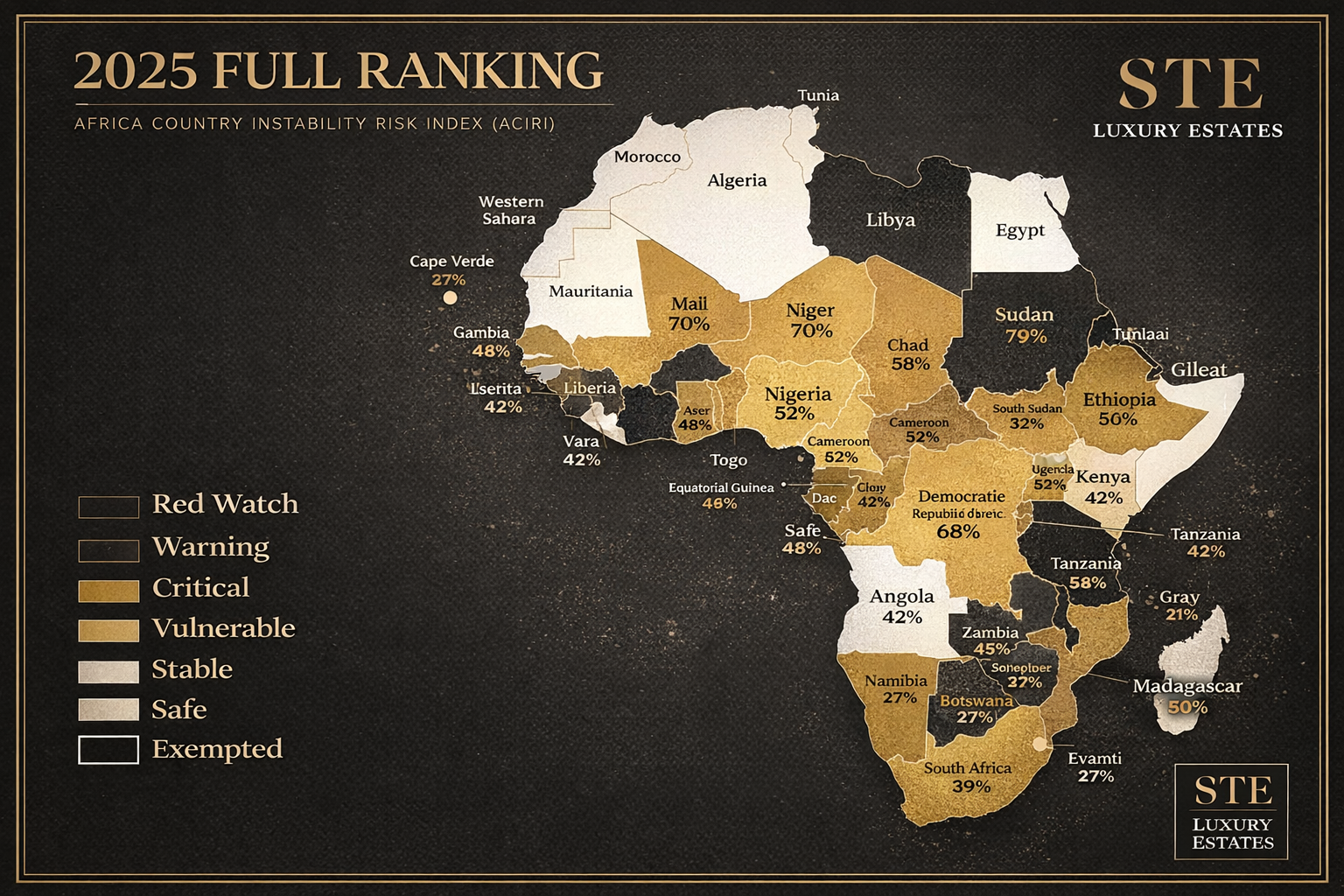
When it comes to choosing where to invest, live, or relocate, stability is often the deciding factor. A new report has confirmed what many in the region already suspected: Mauritius is the safest and most stable country in sub-Saharan Africa.
The 2025 Africa Country Instability Risk Index
The ranking comes from the Africa Country Instability Risk Index (ACIRI), an annual study produced by SBM Intelligence that assesses 48 sub-Saharan African nations on their exposure to political, economic and security risks. North Africa, Mauritania and Western Sahara are left out of the study, since these regions are considered more closely aligned — geopolitically and culturally — with North Africa rather than the sub-Saharan bloc.
To arrive at its rankings, ACIRI combines several weighted factors:
- Leadership and Governance – 40%
- Economy – 30%
- Geopolitics – 15%
- Historical Context – 15%
These are combined into a single score out of 100, where a lower score reflects a more stable country. Based on this score, nations are placed into one of six categories, from the safest (“Safe,” under 30 points) to the riskiest (“Red Watch,” 70 points and above).
Mauritius Tops the Table
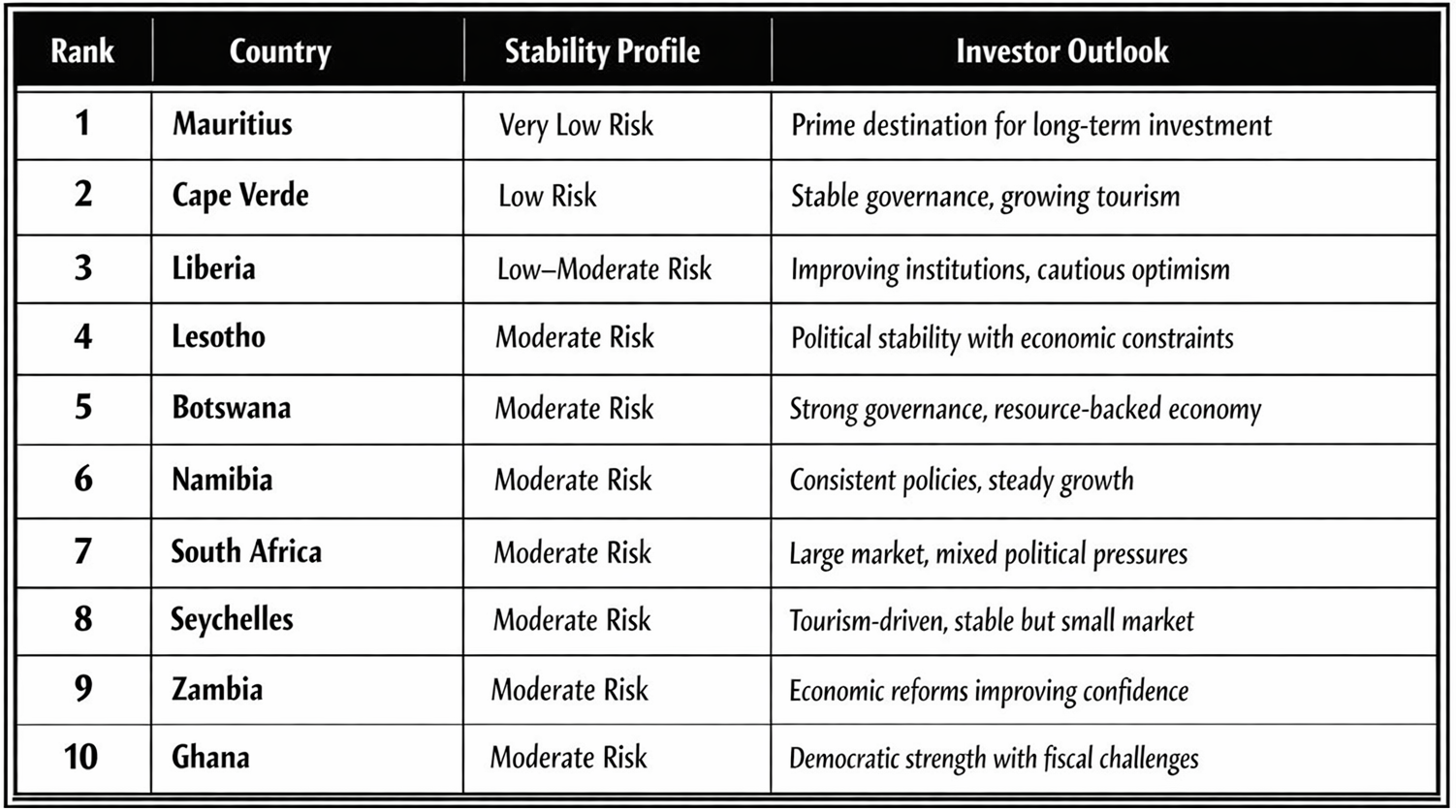
With a risk score of just 17, Mauritius ranks as the safest country on the continent — a reflection of its consistent governance, resilient economy, and low exposure to political or security threats. It’s a position the island nation has built over years of political continuity, sound fiscal management, and a business-friendly environment that continues to attract international investors and residents alike.
Rounding out the top of the list are Cape Verde, Liberia and Lesotho, all recognised for their comparatively stable political and social institutions. Botswana, Namibia and South Africa sit in the middle of the rankings, reflecting moderate but steady stability, while Ghana closes out the top 10 thanks to consistent governance and economic performance.
How the Regions Compare
Beyond individual country rankings, the report also paints a picture of regional trends across the continent:
- Southern Africa remains the most stable region overall, holding an average score of 35.25 — nearly unchanged from the previous year. South Africa’s Government of National Unity marked its first full year in power, alongside fiscal reforms tied to the G20 Common Framework, though ongoing debates over VAT and corruption nudged its score up slightly.
- East Africa experienced the sharpest decline in stability, with its average score rising to 56, up from just over 50 the year before. Political unrest in Kenya and Tanzania, combined with widening fiscal deficits and currency pressures, were the main contributors.
- Central Africa improved marginally to a score of 55.75, though the region continues to be shaped by the M23 conflict in the eastern Democratic Republic of Congo and instability in Chad and Cameroon.
- West Africa’s average ticked up slightly to 45.2, driven by coup speculation in Nigeria and protests over subsidy removals — though broader stabilisation efforts have kept the regional outlook cautiously optimistic.
What This Means Going Forward
As the continent moves into 2026, challenges around governance, security and political continuity are expected to persist — particularly in areas affected by extremist activity and democratic instability. Strong, consistent leadership will remain key to maintaining momentum in the region’s more stable economies.
For Mauritius, this latest ranking reinforces its reputation as one of the safest and most reliable destinations in Africa — not just to visit, but to invest in, do business, and call home.
Considering Mauritius as your next investment destination? At STE Luxury Estate, we help investors take advantage of the island’s stability, favourable investment schemes, and exceptional quality of life. [Get in touch with us] to explore available properties.